


30 Jan A new beginning for the Zambezi: Angola revealed as its true source
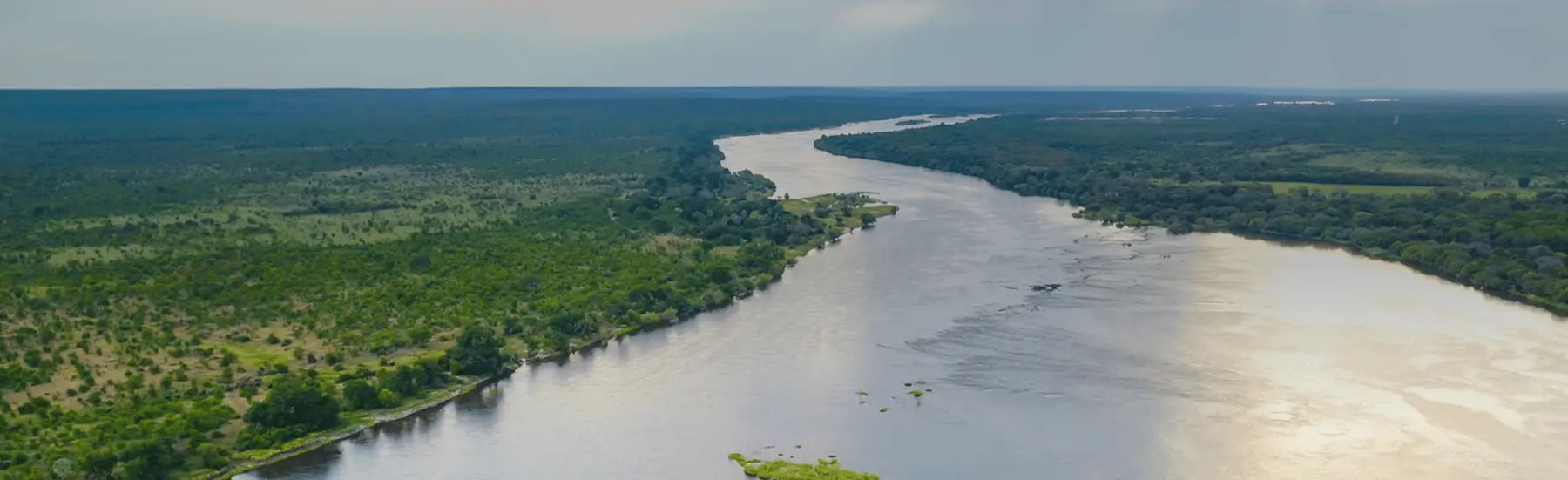
Lovers of the mighty Zambezi River will be surprised to learn that scientists have discovered that the river rises in Angola and not Zambia as previously thought, and that it is 10% longer than anyone suspected.
In addition, researchers from The Wilderness Project (TWP), which was founded in 2018 to study African freshwater systems, including the Okavango River and the Zambezi, have shown for the first time that more than 70% of the water that flows over the Victoria Falls originates from Angola.
Teams from TWP paddled from the traditionally accepted source near Kaleni Hill in north-western Zambia and also along Angola’s Lungwebungu River to ascertain which rose furthest from the sea and calculated that, using the Angolan source, the Zambezi is 342 km longer than previously calculated.
The Lungwebungu River, which rises in the highlands of Angola, flows for 1032 km before joining the Zambezi near Lukulu in western Zambia.
In 2022 and 2023 TWP, in conjunction with the National Geographic Okavango Wilderness Project and the Wild Bird Trust, paddled the entire length of the Zambezi.
The Zambezi is now considered to be 3 421 km long and remains the fourth longest in Africa after the Nile, Congo, and Niger.
“By surveying both headwater sources, and combining high-resolution satellite imagery with our expedition findings, this study reveals that Angola’s Lungwebungu River extends 342 kilometres farther from the ocean than the Zambian source’’ the researchers state in a paper “Assessment of source regions of the Zambezi River: implications for regional water security,” published in the journal Hydrology and Earth System Sciences, in September 2025.
The river rises in what is known as the Angolan Highlands Water Tower (AHWT), a region of high rainfall which gives rise to a number of major other rivers.
In addition, the AHWT contributes almost three-quarters (roughly 70%) of the total flow of the upper Zambezi River. - the researchers state in their paper. This discovery redefines our understanding of the Zambezi system: without the AHWT, the mighty Zambezi would be significantly reduced in flow.
The Lungwebungu flows through deep Kalahari sands which help filter its waters, a cleaning process aided by the vast Cameia wetlands and other natural systems. These wetlands play an ecologically important, but until recently, poorly recorded role in the ecosystem of the upper Zambezi.
This effort marks the first time the Angolan portion of the Zambezi Basin headwaters have been scientifically surveyed.” the researcher’s state.
Much of the region through which the Lungwebungu flows was the scene of intense fighting during Angola’s war for independence (1961–1975) and the civil war (1975–2002), and for decades minefields have made research in the area extremely dangerous and difficult. Research efforts are also hampered by the remoteness of the region.
Most of the large wild mammals of the region including elephant, buffalo, and other animals were killed for food by the forces involved in the conflict.
The Zambezi Basin covers about 1,370,000 km2 spread across eight countries: Angola, Botswana, Malawi, Mozambique, Namibia, Tanzania, Zambia, and Zimbabwe and is home to more than 50 million people.
It is the largest river basin in southern Africa and a significant biodiversity hotspot with more than 200 species of mammals, 700 species of birds, 290 species of reptiles and amphibians, and 190 species of fish have been recorded.
The Zambezi River Basin also plays a key role in the livelihoods of millions of people, but faces increasing environmental challenges from climate change, development, and human water use.
Our teams have spent years exploring and scientifically documenting the AHWT, uncovering its hidden role as the lifeblood of the Zambezi, said Dr. Rainer von Brandis, Research Director for TWP, and – while doing so – showing why protecting it is vital for the future of this mighty river and its people.